01
/
Problem
The Problem
Every day, millions of people step in to care for someone they love, yet our healthcare system often makes that harder than it needs to be. When Ana wants her son Diego to help manage medications, the process involves forms, phone calls, long waits, and repeating the same steps for every provider. Many people eventually give up and share passwords instead. It works in the moment, but creates real security risks. At Pillpack, we saw that about 15% of customers already relied on someone else to help manage their medications, pointing to a broader need for care coordination across Amazon Health.
02
/
Principles
Design Principles
🔐 Care receivers own the keys
The person getting care decides who can help and what they can see. If a caregiver's access conflicts with their wishes, the care receiver wins.
💬 Design for the relationship, not the system
Real care relationships are messy and human. We start there, and when the system gets in the way, we fix it.
🛡️ Boundaries protect trust
Caregiver access belongs in Health Services, not retail. Keeping these spaces separate protects privacy and builds trust.
🗂️ Think system, not use case
Solutions should work across care scenarios, not just one program. Designing broadly keeps the system consistent and scalable.
03
/
analyzation
Understanding the Problem Space
To design something that could work across Amazon Health, I spent time understanding how people actually help each other, how products describe those relationships, and where people struggle in real caregiving journeys.
Relationships Landscape
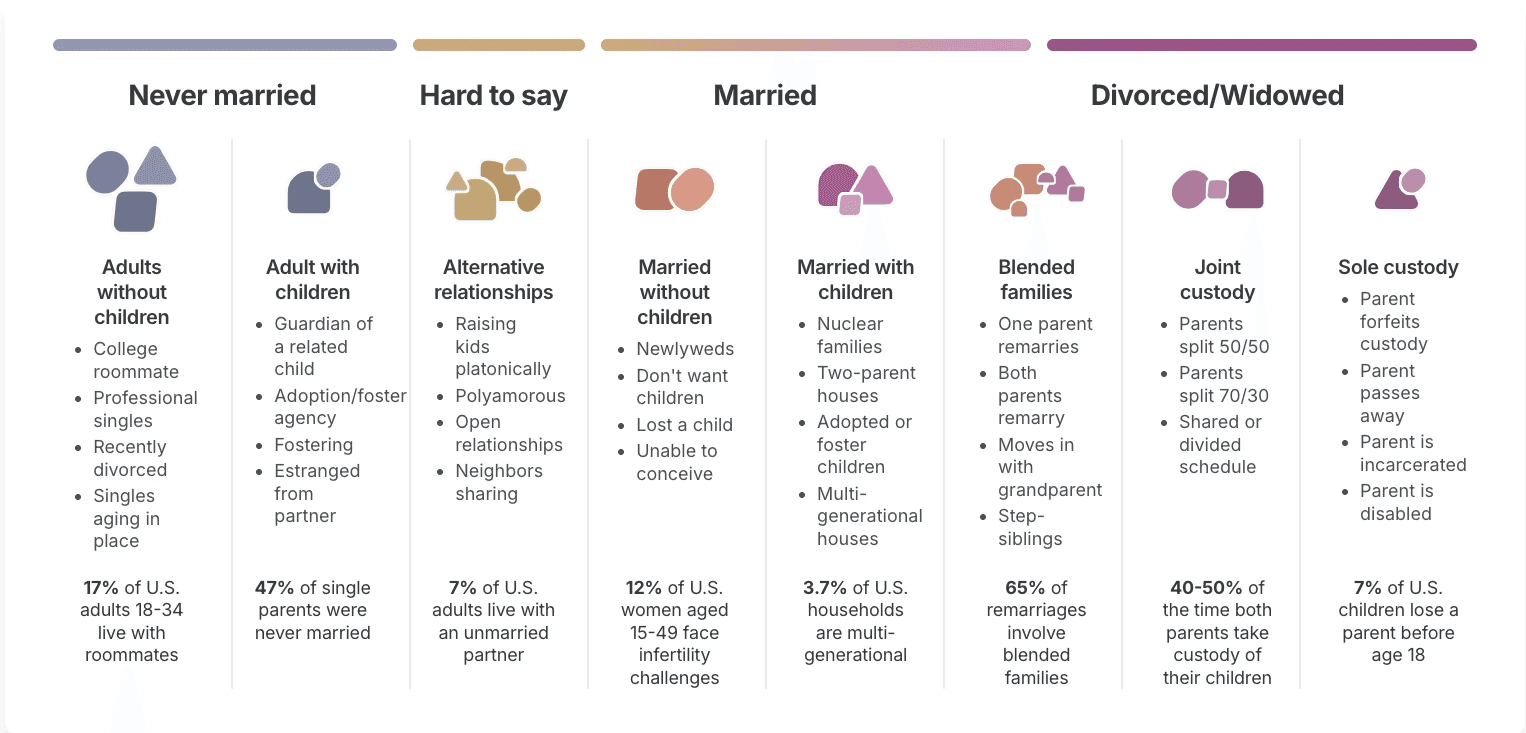
Looking at Amazon household data, I noticed relationships shift over time. To make that visible, I created a visual map of household structures and connections. Spouses support each other, adult children coordinate care across states, and neighbors step in for everyday tasks like picking up prescriptions. Yet healthcare systems often reduce all of this to a single label: "caregiver."
Real care relationships are fluid, and a single role label cannot capture that complexity.
Language Landscape
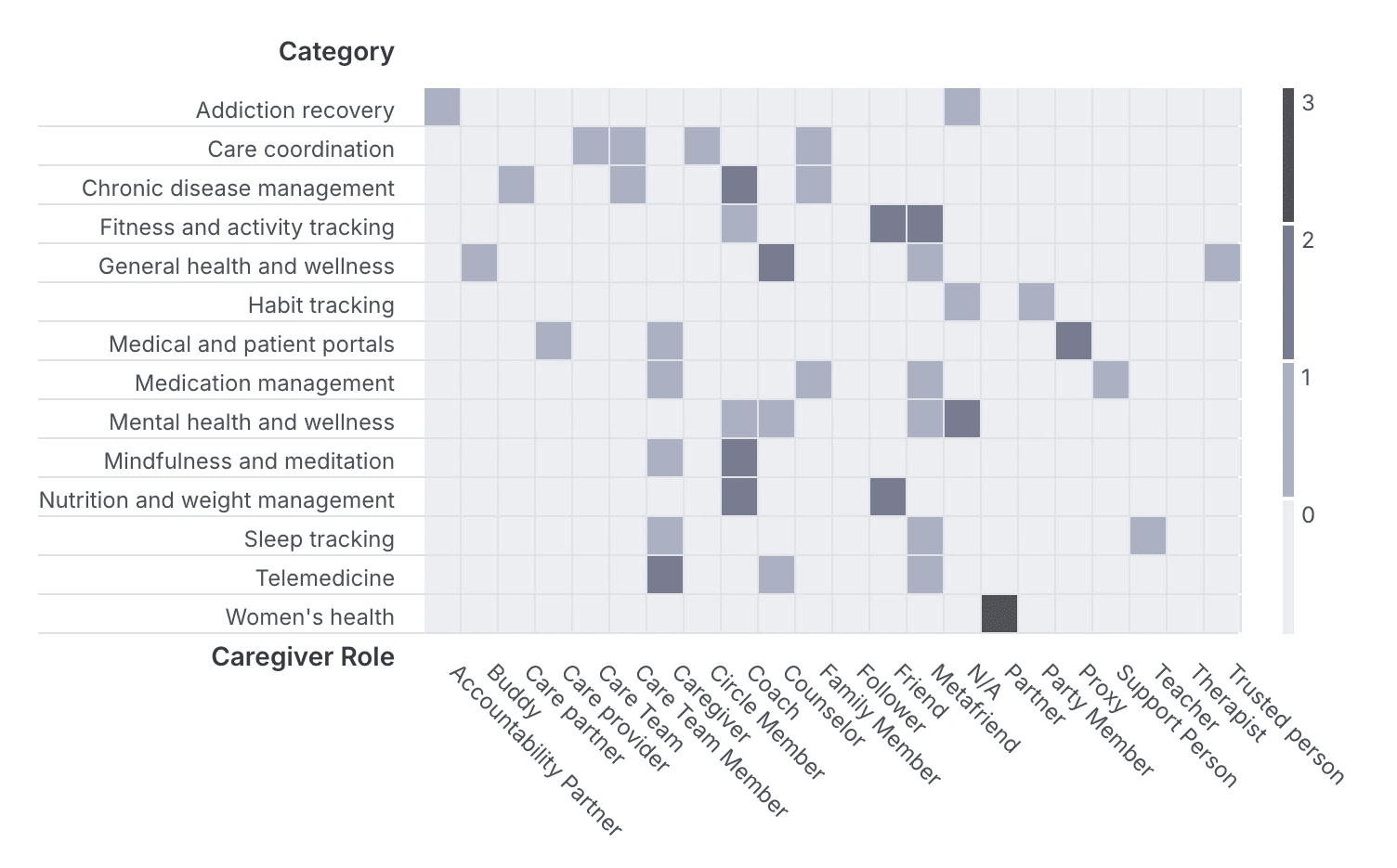
To understand how other products handle this, I analyzed 50 health and wellness apps and mapped the roles they use for people who help manage care. The pattern was clear. Products are slowly moving away from rigid clinical roles and toward language that reflects real relationships.
Fixed role labels may make it harder for people to see themselves in the system.
Personas & Journey Maps
Building on the earlier generative research, I synthesized the patterns into three caregiver personas and journey maps. They helped the team see how different caregiving situations create different needs, pressures, and opportunities for support.

04
/
Decisions
Design Decisions
I designed the core care coordination experience and interaction patterns that allow people to safely involve someone they trust in managing medications. Presenting to 1 SVP, 3 VPs, and 2 Directors across three organizations, I pushed for three decisions that shaped the platform:
💬
Action Based Language
I replaced clinical terms with "Invite someone to help." Results: 42% of people receiving help were new to Amazon Pharmacy, and 8.4% of relationships were mutual.
🔓
Reducing Friction to Enable Helping
I led cross-functional alignment to simplify verification using mobile number plus birth date verification. This established a minimal verification model for care coordination across Amazon Health.
⭐️
Accessibility From Day One
I brought accessibility testing earlier into the process and created office hours to help teams fix issues quickly. This resulted in the first Amazon Pharmacy launch without accessibility blockers.
05
/
Experience
The Experience
Invite someone to help
Add up to six trusted people with a mobile number, with entry points throughout the experience so it's easy to start anytime.
Verify quickly and securely
Verification takes seconds using a date of birth and phone number match, keeping access secure without adding friction.
Stay oriented while helping
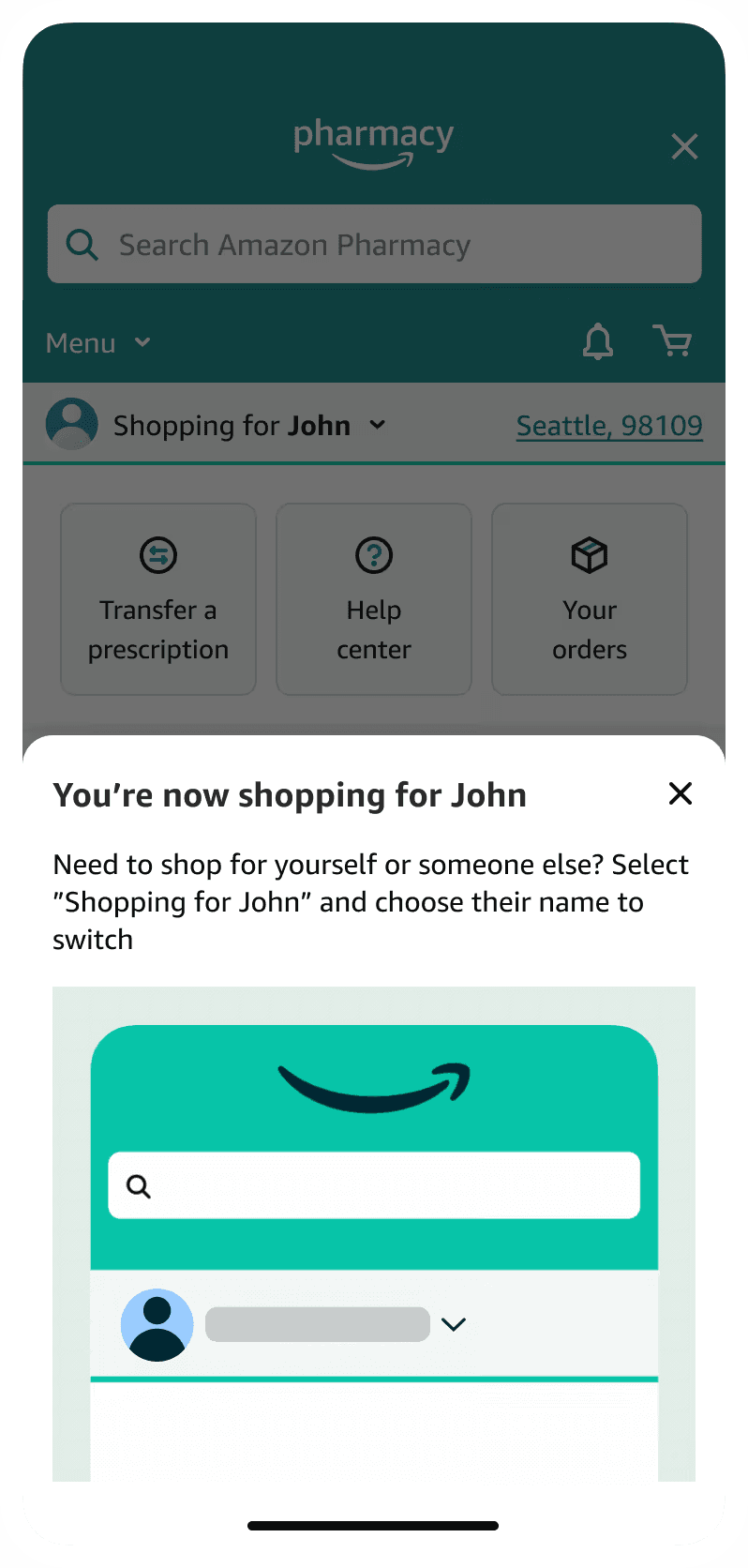
A clear "Shopping for [name]" indicator keeps context visible across Amazon Pharmacy.
Manage medications together
Place orders, manage prescriptions, and handle insurance and programs, all from separate accounts without sharing credentials.
Stay informed and in control
Every action triggers notifications, and access can be updated or revoked at any time through a dedicated Health Access dashboard.

Simple invitation

Secure link

Clear process

Relationship verification
Contextual Education

Access management
06
/
Research
Validation Research
I ran two usability studies with 16 people, testing both the care receiver and helper experience. Both studies used Figma prototypes with people who help manage medications for loved ones, or receive that help.
The invitation flow scored high across the board: 100% task completion, 4.75/5 ease rating. People appreciated that all they needed was a name and phone number.
But the studies also surfaced three problems I needed to fix:
Finding settings was too hard. People averaged 18.75 clicks to find health access management, buried in a menu. I worked with the dashboard team to add a direct entry point, and by week 24 it drove 77% of all traffic to the feature.
Insurance during signup confused people. 87.5% of helpers questioned why they needed to enter their own insurance when they were just helping someone else. I removed the requirement from initial signup and moved it to a later stage.
Profile switching needed a nudge. Helpers needed to understand they were now acting on someone else's account. A bottom sheet shown right after signup achieved 100% task completion in 30 seconds, with zero confusion afterward.
"The simplicity of it is very nice and just the straightforwardness, it's really nice just to be like, I just need a name and phone number and we can get the person authorized to help you... not having to fill out like giant forms to do it. Um, I really like this."
— Research Participant
07
/
Results
Results & Impact
70%
Conversion rate
High conversion showed the experience felt simple and trustworthy for people helping someone they care about.
42%
New customers acquired
Many people receiving help were new to Amazon Pharmacy, expanding the platform beyond existing customers.
30%
People helping placing orders
High conversion showed the experience felt simple and trustworthy for people helping someone they care about.
40%
Faster than projected timeline
Adoption grew faster than forecast as people began inviting trusted helpers.
🧩 Reusable infrastructure
Designed to work across services, not just Pharmacy. Teams are now building on this foundation as care coordination expands to additional Amazon Health programs.
🗂️ Design patterns adopted
Authentication, MFA, and relationship picker components became reusable patterns across health experiences.
🔆 Accessibility practice
Established accessibility office hours and pre-launch play sessions now used by teams across Amazon Health.
What's Next
I authored the product vision for how care coordination scales across Amazon Health, with one core idea: make involving trusted people in your health as natural as sharing Prime benefits. Not a crisis response, but something people do proactively. Teams are now building on this foundation as care coordination expands beyond Pharmacy.
08
/
learning
What I Learned
⚖️
The insurance enrollment compromise taught me to ship and learn. Data validated what the research showed within weeks.
💬
Fighting for natural, everyday language was worth it. The 8% mutual relationships proved we reached beyond traditional caregiving.
🚀
Designing for cross-service scalability from the start means other services can build on this foundation.